There was a specific smell. Sunscreen, cigarette smoke, something frying from a van further up the road, and the particular sweetness of overripe peaches going soft in a bag someone had brought from the market that morning. You were standing at the edge of a departmental road somewhere in France — a road that had been empty until forty minutes ago and would be empty again by tomorrow — and around you were several hundred people who had been standing in roughly the same spot for three hours.
Nobody complained about the wait. That was perhaps the most extraordinary thing about it. Three hours of standing on a thin strip of tarmac in thirty-degree heat, children sitting on shoulders, dogs behaving better than anyone expected, old men in folding chairs who had clearly done this before and knew something the standing people didn't. Then the caravane publicitaire arrived.
The caravane
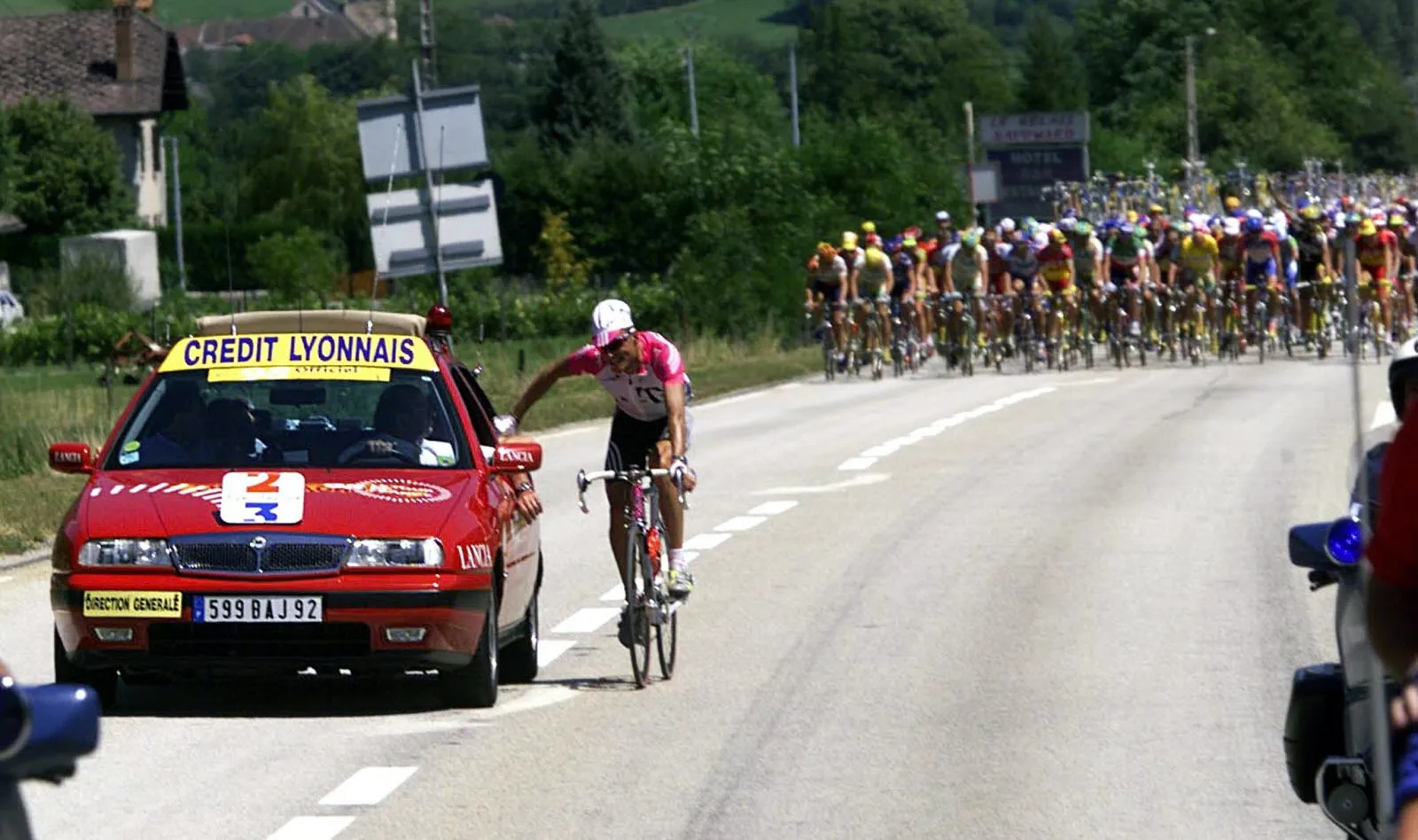
Before any cyclist appeared, before the helicopters, before the gendarmes on motorcycles with their white gloves and theatrical authority — the publicity caravan. A procession of branded vehicles moving through the crowd at walking pace, throwing things. Keychains. Baseball caps. Foam hands. A branded musette if you were lucky and standing in exactly the right spot at exactly the right moment. Salami. There was always, improbably, salami.
The children went insane. The adults pretended not to want anything and then dove for the same things with an unselfconsciousness that the Tour seemed to licence specifically. You could catch a keychain shaped like a piece of cheese from a float shaped like a piece of cheese while wearing a Festina cap you'd caught last year and feel, in that moment, that this was precisely the correct use of an afternoon.
The caravane took twenty minutes to pass. Then silence. Then waiting. Then helicopters.
The helicopters told you everything
This was the pre-smartphone era, the pre-internet era, the era when information about the race came from a transistor radio held to someone's ear and relayed down the roadside crowd in a game of telephone that introduced creative inaccuracies at every stage. Indurain was two minutes ahead. No, fifty seconds. No, two minutes, but it was Pantani now, not Indurain. Someone said Jalabert had crashed. Had he? Nobody knew.
The helicopters settled it. When you saw them approaching from the direction of the race, high and moving fast, you knew the peloton was perhaps ten minutes away. When the motorcycles appeared — the television motos, the commissaires, the team cars threading through — you were down to two minutes. You moved to the barrier. You stopped your sentence mid-word. Everybody stopped their sentence mid-word.
Then the gendarmes on their BMW motorcycles appeared around the corner at a speed that suggested the road behind them was on fire, and the crowd pushed forward with a collective movement that was not quite controlled and not quite chaotic, and someone's radio crackled with a name, and the sound arrived before the image did — a rushing, mechanical, present-tense sound that you could feel in your chest — and then they were there.
They were always faster than you expected
This was the thing nobody warned you about. You'd watched it on television — the TF1 coverage with the helicopters and the graphics and the commentary you could tune in and out of — and television made it look manageable. Men on bicycles, moving quickly, comprehensible as a category of thing.
In person it was something else entirely. The speed of a professional peloton at full pace on a flat descent is approximately 60 kilometres per hour. This number means nothing until you are standing two metres from the road when it happens. The size of the riders — larger than television suggested, the shoulders and legs of men who had ridden three weeks of a Grand Tour — combined with that speed produces a specific violence of air that hits you like something physical.
You had, at most, thirty seconds. Less if the race was strung out rather than bunched, less if there was a break up the road and the peloton was chasing at pace. You looked for the yellow jersey. You looked for the polka dots. You looked for any face you recognised from the Vélo magazine your father kept in the bathroom, from the poster on the wall, from the TF1 coverage the previous two weeks.
Most of what you saw was a blur of colour and effort. Faces you couldn't hold long enough to name. Numbers on bibs that were gone before you read them. Occasionally a rider you recognised — the back of Indurain, unmistakable at the front of the field, riding at a cadence that looked effortless from the outside and was known to be something else entirely from the inside. Pantani's bald head and the ears, always the ears, the ones that preceded him slightly in caricature. Jalabert if he was at the front, Virenque if he was climbing, Armstrong in the later years with his blue-grey USPS kit and the expression that has since been reassessed.
And then they were gone.
The afternoon after the Tour passes
The crowd dispersed slowly, the way crowds do when they've shared something and aren't quite ready to stop sharing it. People gathered their folding chairs and their children and their dogs. The salami was gone. A few Festina caps remained on the ground, unclaimed. The road returned to its normal relationship with silence.
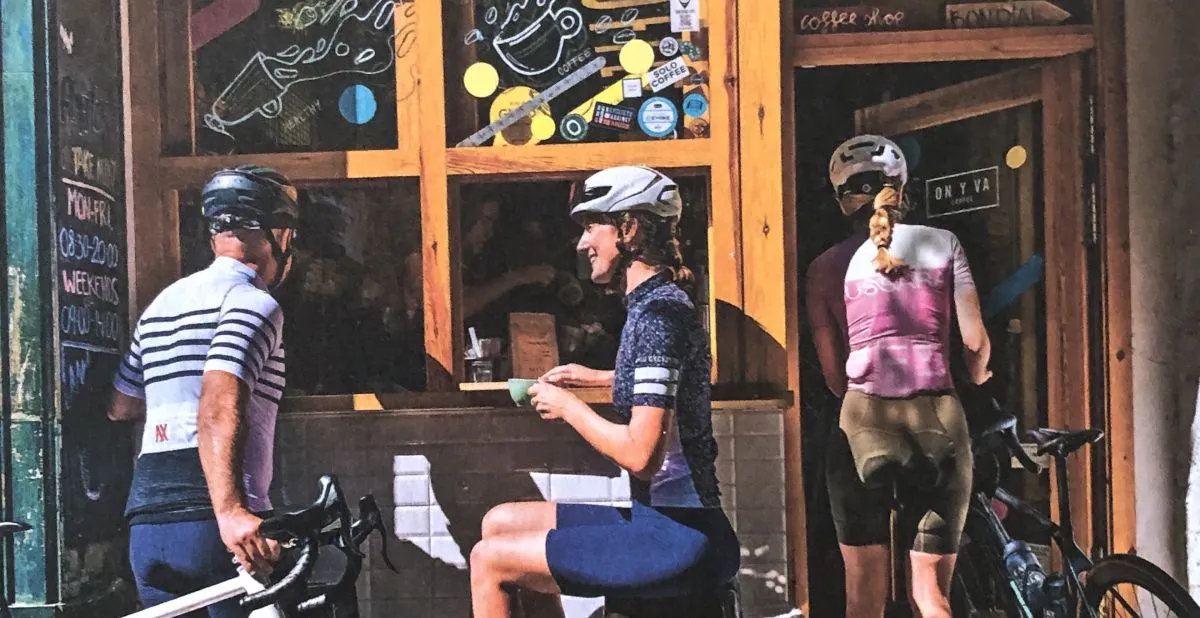
What did you do with the afternoon that remained? In the villages, the cafés filled. Not the tourist cafés — the local ones, with the zinc bars and the television in the corner already replaying footage of the stage, which meant you could see the thing you'd just watched from a perspective entirely different from the one you'd experienced, and this was its own strange pleasure.
You'd been standing at kilometre 147. The broadcast showed it from a helicopter. You couldn't find yourself in the crowd but you could find the corner you'd stood on, and for a moment the experience divided: the personal memory of noise and speed and the smell of overripe peaches, and the broadcast image of a peloton flowing through a village that looked, from above, like water finding its level.
What we knew and didn't know
The 1990s Tour de France was a different sport from any angle you chose to examine it. The riders were different — harder in some respects, less professionalised in others, shaped by a culture that is now largely gone. The equipment was different. The training methods were different.
What we didn't know, standing at the roadside, was what some of that difference meant. The EPO era has since been named, documented, and anatomised in a literature that didn't exist while we were catching keychains from the caravane. The riders we watched and admired and put on our walls were operating in conditions that have since been recategorised.
This knowledge changes the footage. It changes the Alpe d'Huez stages from 1995, the prologue times from 1997, the mountain performances that seemed superhuman because, in certain technical respects, they were. It does not change what the afternoon felt like — the helicopters, the gust of air at 60 kilometres per hour, the thirty seconds that were never enough and always precisely what they were.
The Tour de France was, among other things, a machine for creating memories that survived their own context. The context has changed. The memories remain.
The mountain stages were different
If you were lucky — and luck was the operative variable, because the Tour's route changed each year and placing yourself correctly required either planning or proximity — you went to the mountains.
The Alpe d'Huez crowd in the 1990s was its own civilisation. Camper vans that had been parked for three days on the Dutch corner, the most famous section of the climb, where the orange flags and the Dutch supporters created an atmosphere that was somewhere between a festival and a siege. You walked up through it if you arrived on the day of the stage, threading between the camps and the barbecues and the people who had clearly been there since the previous evening and were either very tired or very happy or both.
The noise on the mountain when the race came through was not comparable to anything you heard on the flat stages. On the flat the riders were moving at 60 kilometres an hour and the crowd had thirty seconds. On Alpe d'Huez the riders were moving at 20 kilometres an hour on the steep sections and you could walk alongside them — literally, if the gendarmes weren't watching — for a moment that stretched. You could hear the breathing. You could see the expression. The famous Tour de France suffering face, documented in ten thousand photographs, was visible from two metres away, and it was more complicated than the photographs suggested: not just pain but calculation, not just effort but strategy, the face of someone doing several things simultaneously and doing all of them at maximum capacity.
Pantani ascending with his dancer's style, out of the saddle, accelerating in a way that made the other riders look suddenly heavier. Indurain on the same climb, seated, cadence metronome-steady, not accelerating and not being dropped, simply continuing at a pace that was sufficient because the calculation was always sufficient. Armstrong in later years, seated, looking sideways at his rivals with something that has since become the most famous look in cycling.
The domestiques
One of the things television couldn't show you — and one of the things the roadside revealed — was the domestiques.
The leaders were comprehensible from broadcast coverage. The general classification battle, the time gaps, the mountain stages — these were the story the television told and the story most people had followed. What television couldn't fully communicate was the economics of the peloton: the riders whose entire Tour was defined by service, by giving wheels and water and shelter and pacing, by chasing down breaks not because they had any hope of winning but because their team leader needed the threat neutralised.
At the roadside you saw them. Riders at the back of the peloton, red-faced and suffering at kilometre 180 of a flat stage, riding at the same speed as the leaders but costing themselves far more to do it. Riders on the final climb of a mountain stage, legs gone, dropped by the front group fifteen kilometres ago, still pedalling because the stage wasn't over and the job wasn't finished until you crossed the line. The Tour de France, from the roadside, was not the story of eight or ten men fighting for the yellow jersey. It was the story of 150 people doing one of the hardest things humans have voluntarily done, and most of them were doing it in complete anonymity.
The race we were watching
The TF1 broadcast in the evenings — which you watched in the chambre d'hôtes or at the campsite bar or in the village café, whichever applied — organised the day into narrative. The camera had followed the leaders. The graphics showed the time gaps. The commentators explained what had happened and what it meant for tomorrow.
The roadside gave you something different: the unorganised, unnarrated event as it actually was. The peloton from the inside out rather than the broadcast's outside in. The noise that television couldn't transmit. The air pressure of 150 riders at speed. The intimacy of being physically present at something that was simultaneously ordinary — men on bicycles, on a road — and utterly extraordinary in context.
The Tour de France was both of these things and it was neither of them separately. You needed the television to understand what you'd seen. You needed the roadside to understand why the television coverage wasn't sufficient.
What we were standing there for
There's a moment, in any account of watching sport in person, where the question of why becomes relevant. The preparation, the travel, the hours of waiting, the thirty seconds — was it worth it?
The question answers itself by the roadside. You were not there for information about the race. You were not there for a superior view. You were there because the Tour de France is one of the few events in European culture that comes to you — that arrives on a road near a place you might actually be, uninvited, free of charge, and leaves without asking anything in return except your attention.
You were there because the peloton passing at sixty kilometres per hour is something you feel in your body rather than process in your mind, and the body's knowledge of the event is different from the mind's knowledge of it. You were there because the summer in France has a quality that the Tour summarises better than anything else — the long afternoons, the heat, the plane trees, the café in the village square, the sense that the afternoon is a thing to be inhabited rather than endured.
You were there, perhaps, because you were young and it seemed like the kind of thing you should be there for, and you were right.
What you kept
The Festina cap is long gone. The foam hand from the caravane lasted two summers. The keychain shaped like cheese — actually a promotional item for a regional dairy that no longer exists — was lost at some point in the late 1990s in a move or a clear-out or simply the attrition of objects that don't survive twenty-five years.
What survived was the thirty seconds. The noise and the air pressure and the specific quality of being present for something that didn't require your presence and happened anyway. The peloton at kilometre 147 on a stage you can no longer precisely name, on a road in a département you might be able to identify from a map but can't locate from memory, on a day that was hot and long and entirely, specifically itself.
The Tour still comes. The roads are the same roads. The caravane still throws things. The helicopters still arrive before the riders. The crowd still stops its sentences mid-word.
What's different is that you know, now, what thirty seconds actually is. You know how fast it passes and what it contains and what you get to keep afterward. When you were young and standing at the roadside for the first time, you didn't know any of that yet.
You were about to find out.