Mont Ventoux · 6 June 2026 · Christophe
The Triple Ascent — Ventoux in a day
Provence · Road · 135 km · 4 800 m · For the slightly unhinged

The reference ascent
22 km
Distance
1,579 m
Elevation
1h40
Duration
2 ravitos
Ravitos
There is no climb in cycling quite like Ventoux. Not because it is the hardest — there are longer climbs, steeper climbs, climbs with more brutal gradients. But no other mountain concentrates so much cycling mythology into a single road. Coppi rode here. Simpson died here. Pantani and Armstrong had their reckoning here. Every serious cyclist who comes to Provence eventually stands at the bottom of the Bédoin road, looks up at the white summit visible from thirty kilometres away, and begins.
The ascent from Bédoin is the reference route. Not the easiest, not the hardest — the one that defines what Ventoux is. It is the side from which the mountain shows its full character: a forested approach that lulls you into a false sense of pace, a transition at Chalet Reynard where the trees end and the limestone begins, and then six kilometres of exposed white rock under open sky that can be brutal in heat, murderous in wind, and unforgettable in any condition.
Bédoin is a village of 3,000 people at the foot of the mountain's southern slope, 280 metres above sea level. It has a pharmacy, a bakery, a weekly market on Monday mornings, and Café du Cycliste — the most logically named cycling destination in France, situated at the base of the climb that defines the region.
Fill your bottles before you leave the village. There is water at Chalet Reynard (km 15) and theoretically at the summit, but on busy summer days the summit facilities are unreliable. Treat everything above Chalet Reynard as a desert.
If you are climbing in July or August, leave before 8am. The Ventoux summer heat is serious. The road above the treeline has no shade whatsoever and the combination of gradient and temperature is not something to discover by accident at 11am.
The road leaves Bédoin through vineyards and cherry orchards on a gradient that feels almost friendly. This section is the warmup and should be treated as such. The instinct on a famous climb is to attack immediately. Resist it. The mountain will provide all the suffering you need without any help from bad pacing decisions in the first six kilometres.
Saint-Estève is a small cluster of houses at the beginning of the forest. The road turns sharply right here and the gradient changes character immediately. This is where the climb begins in earnest.
Nine kilometres through Cédric forest at an average of 9%. This is the heart of the Bédoin ascent and its defining section. The road winds continuously — no straight stretches of any length — through pine and oak forest that provides shade in summer and a cathedral-like quiet in spring and autumn.
The gradient is rarely below 8% and regularly touches 11–12% on the inner curves. The road surface is generally good. The difficulty is the relentlessness: there is no flat section, no recovery moment, nothing but the next corner revealing another ramp at the same angle.
This is where pacing decisions made in the first six kilometres become relevant. This is also where Ventoux begins to filter between the riders who will summit comfortably and those who will suffer.
The key sections to manage:
Km 8–10 — the gradient averages 10.5% through the tightest section of switchbacks. Many riders accelerate here out of impatience with the trees and the sameness of the view. Don't.
Km 12–14 — the forest thins and the gradient eases slightly to 8%. This is the moment to breathe, not to accelerate.
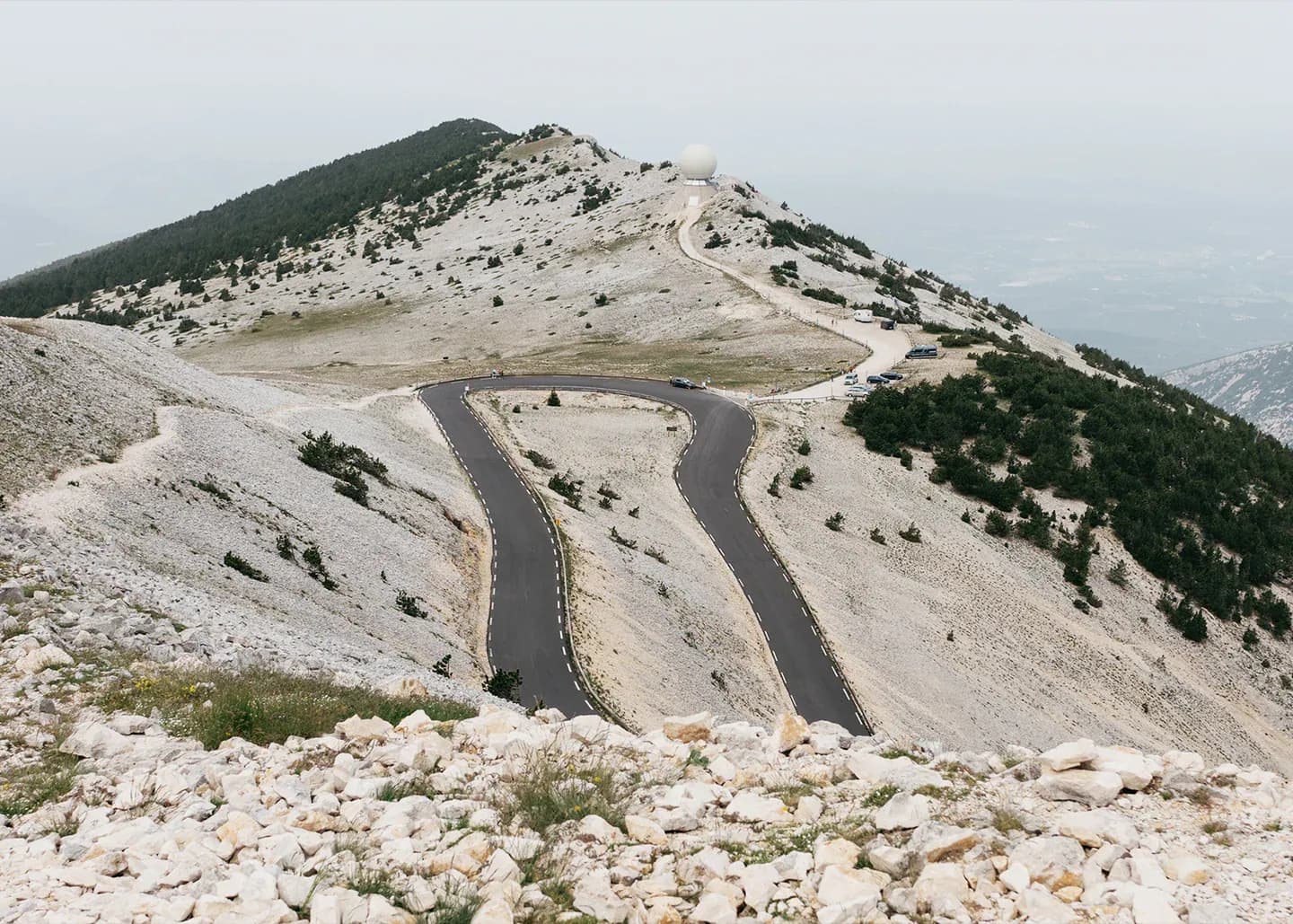
At Chalet Reynard (1,440m) the trees end without warning. The road emerges onto open limestone and the full scale of the mountain becomes visible for the first time. The summit — the meteorological station on the ridge at 1,912 metres — is directly ahead, 477 metres above, across terrain that looks like nothing else in France.
The white limestone scree, the absence of any vegetation, the road cutting a pale line across pale rock — this is what makes Ventoux unique. It looks wrong, like a mountain that belongs somewhere else. On a clear day the Mediterranean is visible to the south, the Alps to the east, the Cévennes to the northwest. On a cloudy day the cloud is often below you.
The gradient from Chalet Reynard to the summit is 7.6% average, which sounds like relief after the forest but is not, because the exposure begins immediately. The Ventoux wind — mistral or otherwise — meets you on the ridge with nothing to impede it. In summer the heat radiates from the rock without shade to interrupt it. The combination of sustained gradient, exposure, and environmental stress is what gives the summit its particular quality of achievement.
Tom Simpson's memorial is at km 20, 1.5 kilometres below the summit, marked by a small stone monument. Simpson collapsed and died here during the 1967 Tour de France, in heat, at the end of a stage that started in Marseille. It is worth stopping. Not long — a minute, a look, a moment to consider what the mountain was capable of before anyone had heard of it.
The final kilometre includes the tommy section where the gradient kicks to 10% before the road rounds the final bend and the summit plateau appears.
The summit of the Ventoux is at 1,912 metres. There is a meteorological station, a television antenna, a souvenir shop, and — depending on the season and time of day — a great deal of wind. The views are exceptional when the weather is clear and non-existent when it is not.
Temperature drop from Bédoin to summit: 12–15°C on a typical summer day. A light windproof layer is not optional above Chalet Reynard.
The descent: The road back to Bédoin retraces the ascent. Brake early into the corners in the forest — the gradient is steep enough that speed builds faster than most riders expect. The descent takes 35–45 minutes. There is no need to hurry.
Café du Cycliste — Ventoux Store · 286 Route du Mont Ventoux, Bédoin. The only place to start this climb. Specialty coffee, pastries, gear, local knowledge, and the specific atmosphere of a place that exists because of the mountain above it. Open Monday and Wednesday–Sunday from 10:00.
The Ventoux has three ascents. The Bédoin road is the hardest and the most celebrated. The other two are different mountains in the same sense that three sides of a triangle are different lines — the summit connects them, but everything else about the experience changes.
21 km · 1 532 m · avg 7.2% · Technical and varied
Malaucène sits at the foot of the northern slope, 330 metres above sea level, a village with a weekly Friday market and considerably fewer cyclists than Bédoin. The ascent from Malaucène is technically similar to Bédoin in length and elevation gain but different in character — more technical, more varied, with sections of genuine difficulty followed by brief reprieves.
The climb
The road leaves Malaucène through village streets before immediately entering forest. The gradient is irregular — something that Bédoin is not — alternating between 10%+ ramps and short sections of 4–5% where recovery is possible. This irregularity is either more manageable or more difficult than Bédoin depending on your physiology. Riders who climb well at steady pace prefer Bédoin. Riders who climb better with rhythm variation often prefer Malaucène.
The key distinction from Bédoin: the Malaucène road meets the summit road at the Col des Tempêtes, 1.5 kilometres below the summit, rather than at Chalet Reynard. The final exposed section is shared with the Bédoin descent, but approached from the opposite direction. You see the summit earlier, which is either motivating or demoralising depending on the state of your legs.
The spring advantage
The northern slope holds snow longer than Bédoin but opens earlier to cycling because it is north-facing and shaded through the morning. In April and early May, when Bédoin is sometimes still closed by late snow, Malaucène is often open. The forest is darker, cooler, and in spring dramatically carpeted with wildflowers on the lower slopes.
From the summit, the descent options
Practical note: Water in Malaucène before you leave. The only café on the Malaucène road is at the summit — there is nothing reliable in between. The northern slope can be cold even in summer; take a layer.
26 km · 1 210 m · avg 4.7% · The accessible giant
Sault is a small town on the eastern plateau, 765 metres above sea level, surrounded by lavender fields that are the visual signature of Haute-Provence in summer. The ascent from Sault is Ventoux's longest approach by distance and its gentlest by gradient — a road designed, it sometimes feels, for people who want to see the mountain rather than suffer on it. That is not a criticism.
The climb
The road leaves Sault across the plateau on gradients that rarely exceed 5% for the first 15 kilometres. This is the Ventoux as a long ride rather than a hard climb — the kind of ascent where conversation is possible, where looking at the landscape is not a distraction from survival, where the summit accumulates gradually rather than arriving as the consequence of a violent effort.
At the Col de Murs junction the road steepens and eventually joins the summit road at Chalet Reynard (km 21 from Sault). The final five kilometres are shared with the Bédoin ascent — the exposed limestone section, the same gradient, the same wind.
Who this route is for
The Sault approach is the right answer for several specific situations: riders returning from injury or illness who want to summit without a maximal effort; riders who have already climbed Bédoin and want a different experience; groups with mixed abilities where the faster riders can go ahead and the slower riders will not suffer unnecessarily; anyone who wants to arrive at the summit having enjoyed the ride rather than survived it.
It is also the route that delivers the most varied landscape. The lavender fields below Sault in July are one of the genuinely extraordinary views in Provence. The eastern plateau has a light and openness that the forest roads of Bédoin and Malaucène cannot provide.
The summit from Sault
Because the Sault road joins the Bédoin/Malaucène summit road at Chalet Reynard, the final section to the summit is identical regardless of which approach you take. The summit, the views, the Simpson memorial — all the same. The difference is entirely in how you arrive at Chalet Reynard.
The lavender circuit option
Sault is the base for one of Provence's great cycling loops: Sault → Ventoux → descent to Bédoin → D19 via Mormoiron → Mazan → Caromb → Crillon-le-Brave → Bédoin → return to Sault via the D942. Approximately 110 kilometres, 2,000 metres of elevation, lavender country in the morning and the Dentelles de Montmirail in the afternoon. A full day that requires nothing more than starting early and stopping when the legs say stop.
Practical note: Sault has a good weekly market on Wednesday mornings — the best in the Ventoux region after Bédoin Monday. The lavender cooperative in town sells the only lavender honey worth buying.
Café du Cycliste — Ventoux — the only certified stop in Bédoin. Start and finish here regardless of which approach you take. The team knows the mountain in every condition.
22 km
Distance
1,579 m
Elevation
7.5%
Average gradient
1,912 m
Summit altitude
From Malaucène
21 km · 1564 m · 7.2%
Strava route : https://www.strava.com/routes/3498673936069005696
From Sault
26 km · 1211 m · 4.7%
Strava route : https://www.strava.com/routes/3498677187261123456
Before you go
From the journal

Mont Ventoux · 6 June 2026 · Christophe
Provence · Road · 135 km · 4 800 m · For the slightly unhinged
Get the Ravito guide in your inbox.
No noise. Unsubscribe anytime.