Expedition
Nice · 18 July 2026 · Simon
What Nobody Tells You About a 4-Day Cycling Trip in the South of France
Read →3 min read
Marvin · 26 July 2026 · 6 min read · 8 views
There's a number that means something to anyone who follows this sport, and it isn't a distance, a gradient, or a finishing time. It's 525 — the tally of professional wins credited to Eddy Merckx, a total so far beyond what any rider before or since has managed that it reads less like a statistic than a kind of scripture. Somewhere in Flanders, someone decided that if any distance deserved to carry that number, it should be a bike route. The result runs from Tongeren, in the province of Limburg, to Ypres, on the old front line of the First World War — 525 kilometres and just under 6,000 metres of climbing, cutting straight through the region that gave road cycling its most devoted following.
Call it a pilgrimage if the word doesn't feel too heavy. Flanders has never been shy about treating cycling as something close to faith — chapels to the sport's saints, shrines built from cobblestones, congregations that gather twelve deep on a hillside in March rain to watch riders suffer for an afternoon. A 525-kilometre route through the heart of that culture isn't really a metaphor. It's closer to a description.
Tongeren, and the first climbing you didn't expect
The route starts in Belgium's self-proclaimed oldest city, beneath a statue of Ambiorix — the Eburonian chieftain who gave Julius Caesar's legions real trouble two thousand years before anyone here had heard of a bicycle. From there, the road turns immediately into Haspengouw, and the first illusion falls away fast. Flanders has a reputation for flatness that this stretch does nothing to earn. The land rolls in long, orchard-lined waves, rising and falling without ever quite settling, and climbs like the Kolmontberg and the cobbled sector at Manshoven — both used at the 2024 European Road Championships — make clear that this region is only beginning to write its own cycling history, not borrowing someone else's.
Sunken roads and a mural in a farm village
West of Sint-Truiden, the orchards of Haspengouw give way to the Hageland, where the defining feature isn't a climb but a kind of geological scar: centuries of cart wheels and rain have carved the local roads down into the clay, so that riders pass between earthen walls taller than a person, tree roots overhead like a low ceiling. It's beautiful and slightly unnerving in equal measure, particularly on the descents.
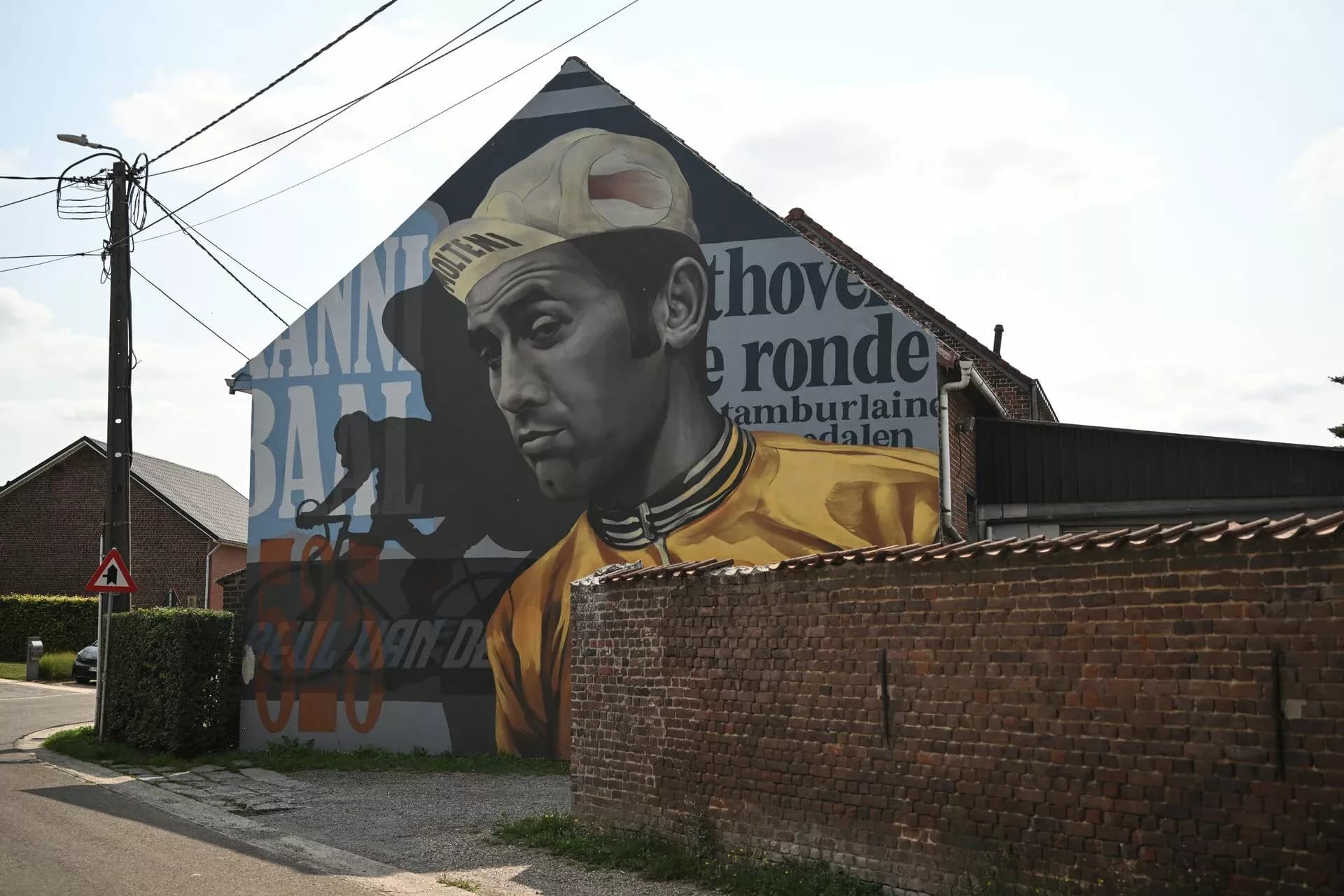
Somewhere in this stretch sits Meensel-Kiezegem, an unremarkable farm village that happens to be where Eddy Merckx was born. A café called 't Klein Verlet sits opposite the house, its side wall covered in a mural of the man locals still simply call the Cannibal. There's a statue too, unveiled in 2015. It's a strange thing, standing in front of a childhood home turned monument — a reminder that greatness in this sport is manufactured less in training camps than in villages exactly like this one, with names most people outside Belgium will never learn to pronounce.
Leuven, and the weight of what's still ahead
By the time Leuven's market square comes into view, a rider will have covered roughly 125 kilometres — a natural point to stop for the night, and a fitting one. The city's cobbled Ramberg climb, added to the route of the 2024 UCI Gravel World Championships, and its role as host of the 2021 Road World Championships, where Julian Alaphilippe rode into the rainbow jersey, both live on in the roads that follow. It's worth not looking too closely at the elevation profile for the next fifty kilometres. Some things are better discovered one pedal stroke at a time.
The punishment begins in earnest
Past Huldenberg, Tervuren, and Overijse, the route absorbs some of the Brabantse Pijl's meanest terrain — climbs that rarely make headlines outside Belgium but that punish exactly as hard as anything in the more famous spring classics. The Smeysberg carries a road sign warning of 17 percent; the cobbled Moskesstraat, not far behind, argues that the sign undersold it. Street art here pays tribute to the sport's more recent saints — Boonen, Cavendish, Sagan, Vos — a reminder that devotion in Flanders isn't only historical.
Then, almost as a mercy, the route slips into the Sonian Forest, where new asphalt turns without warning into pale gravel and centuries-old beech trees rise overhead like columns in a cathedral no one built on purpose. By the time the trees thin out again, roughly 200 kilometres will have passed beneath the wheels.
Beer, then the reckoning
South-west of Brussels, the Pajottenland offers something closer to a reward than a test: geuze country, where oak barrels age the region's sharp, long-lived beer like a fine vintage, and a stop at a brewery like 3 Fonteinen counts as legitimate route research. It's also, briefly, flat — a stretch of towpath toward Halle that may be the first genuinely level riding since Tongeren.
It doesn't last. Past Halle, the road turns toward the Flemish Ardennes, and what follows is less a bike route than a relic tour: the Bosberg, the Muur van Geraardsbergen, and then — after a stopover that most riders will need, in a town with cycling cafés dense enough to double as pilgrimage sites of their own — the long, punishing sequence that gives this region its reputation. Tenbosse, Valkenberg, Berendries, Haaghoek, Eikenberg, Molenberg, the Koppenberg, the Taaienberg, the Paterberg, and finally the Oude Kwaremont, climbed here just once, unlike the three ascents professionals endure each April. By the time the road flattens into Oudenaarde and then Kortrijk, the accumulated gradient will have tested tendons that Haspengouw's rolling orchards only warmed up.
Into Flanders Fields
The final stretch retraces Gent–Wevelgem's route toward Ypres — gravel "plugstreets" named for British soldiers who couldn't manage the Flemish village name Ploegsteert, war cemeteries scattered through fields and backyards with the same quiet regularity as farmhouses, and finally the Kemmelberg, the region's one true mountain in an otherwise level landscape, its cobbled final stretch climbing past 20 percent toward a monument to French soldiers who died defending the hill.
Ypres arrives in a slow descent, the medieval Cloth Hall's belfry visible from far off — the tallest building north of the Alps when it was completed in the thirteenth century. The natural place to stop pedalling is directly beneath the Menin Gate, where the Last Post has sounded every evening since 1928, war or no war, rain or shine.
One more stop, if there's anything left
For riders who haven't quite had enough, an extra 25 kilometres links Ypres to Roeselare and the KOERS museum — home to more than 300 historic bicycles and a full collection of Eddy Merckx's race jerseys, a fitting place to end a route that started, in a sense, with his name.
Ultimate Flanders 525 isn't a route built for speed, and it doesn't pretend to be sacred in any literal sense. But something about tracing the region's defining climbs and cafés and war memorials in a single unbroken line does the same thing the best pilgrimages have always done: it turns a landscape you thought you understood into something you've actually earned the right to know.
Weekly guide
More from the Journal
Nice · 18 July 2026 · Simon
Mont Ventoux · 6 June 2026 · Christophe
Provence · Road · 135 km · 4 800 m · For the slightly unhinged
Pyrenees · 16 May 2026 · Christophe
Five days. Four riders. One route. The premise was simple: gravel bikes, minimal bags Everything else we figured out on the road.
Get the Ravito guide in your inbox.
No noise. Unsubscribe anytime.