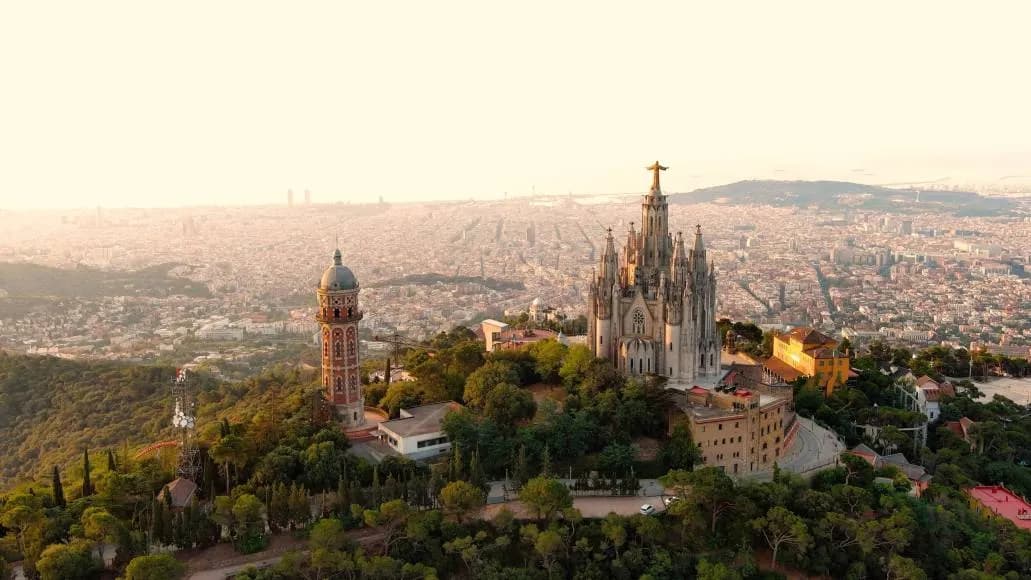
The Barcelona Weekend Loop — Tibidabo, Sant Cugat, Vallvidrera
The loop every Barcelona cyclist knows. Up the Tibidabo via l'Arrabassada, over to Sant Cugat, back through Vallvidrera. 37 km, 762 metres, two hours. The city behind you before the coffee is finished.
37 km
Distance
762 m
Elevation
2h09
Duration
2 ravitos
Ravitos
Barcelona has a mountain. Most cities at the edge of the Mediterranean do not — they have a hill, or a headland, or a ridge that the hotels occupy. Barcelona has the Serra de Collserola rising directly behind the city, 500 metres above sea level, forested, crossed by a handful of roads that every serious cyclist in the city knows by name and by gradient. The Tibidabo is the highest point. The loop that goes up one side, crosses to Sant Cugat, and returns through Vallvidrera is the standard format for a Saturday morning.
It begins somewhere in the city — the Eixample, Gràcia, Sarrià, wherever you sleep — and the common thread is the Carretera de l'Arrabassada, which is the fastest and most direct road onto the Collserola from the urban fabric of Barcelona. The road starts near the Ronda de Dalt, immediately gains altitude through a series of curves above the city, and delivers you onto the flank of the mountain with the urban sprawl already below and the pine forest already around you. This transition — from Barcelona to Collserola in under ten minutes — is the defining quality of cycling here. The city does not ease into the mountain. It stops, and the mountain begins.
The Arrabassada climb itself is 6.9 kilometres at 5% average from the Ronda de Dalt, with a steeper upper section that kicks above 7% before the road flattens and joins the summit plateau. The gradient is honest but not punishing — a good-tempo climb rather than a threshold effort, the kind of ascent that warms the legs rather than empties them. On a Saturday morning, you will not be alone: this is one of the most ridden climbs in the city, and the population of riders on it between 7am and 10am reflects that. The etiquette is Barcelona cycling etiquette — relaxed but purposeful, polite on the corners, competitive on the straight sections if the legs feel good.
At the summit, Plaça del Tibidabo at 501 metres: the amusement park on the left, the Temple Expiatori del Sagrat Cor directly above, the Torre de Collserola telecommunications tower visible through the trees. The city is below in every direction — the sea ahead, the Pyrenees behind, the coastal plain spreading south to the delta of the Llobregat. There is a café at the summit. Whether you stop here depends on what kind of ride you are having.
The descent to Sant Cugat begins on the western side of the summit, dropping via the Carretera de Sant Cugat a Barcelona — 8 kilometres of descent through the Collserola forest, winding, fast in the upper sections, more technical in the lower ones where the road crosses small ravines and the gradient varies. This is the quieter side of the mountain: fewer cars than the Arrabassada, more forest, the road occasionally narrowing before it opens again above the plain of the Vallès. Sant Cugat del Vallès appears below — a commuter town with a Benedictine monastery and a café culture that belongs to its proximity to Barcelona rather than to any independent identity.
The stop in Sant Cugat is the social beat of the loop. There are several cafés near the monastery, the standard format being an espresso and a croissant at a table on the terrace while the legs recover and the group debates whether to extend the route or return directly. The extension options from Sant Cugat are numerous — further into the Vallès, west toward Molins de Rei, north toward Terrassa — but the loop as described turns back east here.
The return to Barcelona follows the Carretera de Vallvidrera — a road that climbs back through the Collserola from Sant Cugat to the village of Vallvidrera, crosses the ridge, and descends on the Barcelona side into Sarrià. The climb from Sant Cugat to the ridge is gradual and forested, the road less trafficked than the Arrabassada, the surface good. Vallvidrera itself is a mountain village absorbed into the administrative fabric of Barcelona but retaining a separate character — quiet streets, detached houses, the funicular station that connects it to the city below. The descent from Vallvidrera into Sarrià is short and fast, the road joining the urban network quickly and depositing you back in the city in time for a second coffee.
The loop is 37 kilometres. It takes between 1h45 and 2h30 depending on pace, group size, and how long you stay in Sant Cugat. It can be done before work on a weekday if you start early enough. On weekends it is a social institution — the same riders, the same roads, the same café, the same discussion on the descent about where to eat lunch. This consistency is not repetition. It is the point.
Route
37.65 km · +762 m · Road
| Segment | Notes |
|---|---|
| Barcelona → Ronda de Dalt | Urban link — varies by starting point (Eixample, Gràcia, Sarrià) |
| Carretera de l'Arrabassada | 6.9 km · 5% avg · kicks above 7% in the upper section |
| Plaça del Tibidabo (501 m) | Summit plateau — café, views over Barcelona and the sea |
| Tibidabo → Sant Cugat | Carretera de Sant Cugat a Barcelona — 8 km descent, forested, technical lower section |
| Sant Cugat del Vallès | Coffee stop — cafés near the monastery |
| Sant Cugat → Vallvidrera | Carretera de Vallvidrera — gradual climb back through the Collserola |
| Vallvidrera → Sarrià → Barcelona | Short fast descent, rejoins the city quickly |
37 km
Distance
762 m
Elevation
5%
Average gradient
507 m
Summit altitude
Before you go
- The Arrabassada on a weekend morning is sharedBetween 7 and 10am on Saturdays, this road carries a significant volume of cyclists of all levels alongside cars. Hold your line, signal your intentions, and ride the corners as if something is coming the other way — because it often is.
- The descent to Sant Cugat Is faster than it looks on the map. The upper section is open and quick; the lower section tightens considerably as the road drops toward the plain. Brake early on the corners you don't know yet.
- The café stop in Sant Cugat is load-bearingThis loop at 37 km doesn't require a refuelling stop in terms of energy management, but the stop in Sant Cugat is where the loop earns its social logic. The monastery square has several options. Budget 15–20 minutes if you're riding with people.
- Early start in summerThe Collserola forest holds shade well, but the descent to Sant Cugat and the initial urban climb can be hot from 10am onwards in July and August. Leaving at 7am gives you the mountain in cool air and means you're back in the city before the heat builds.
- The Vallvidrera descent into Sarrià is shortIt rejoins the urban road network quickly and the traffic picks up immediately. Come off the mountain at the pace you're comfortable sustaining on city streets — the transition from Collserola to Barcelona happens faster than you expect.