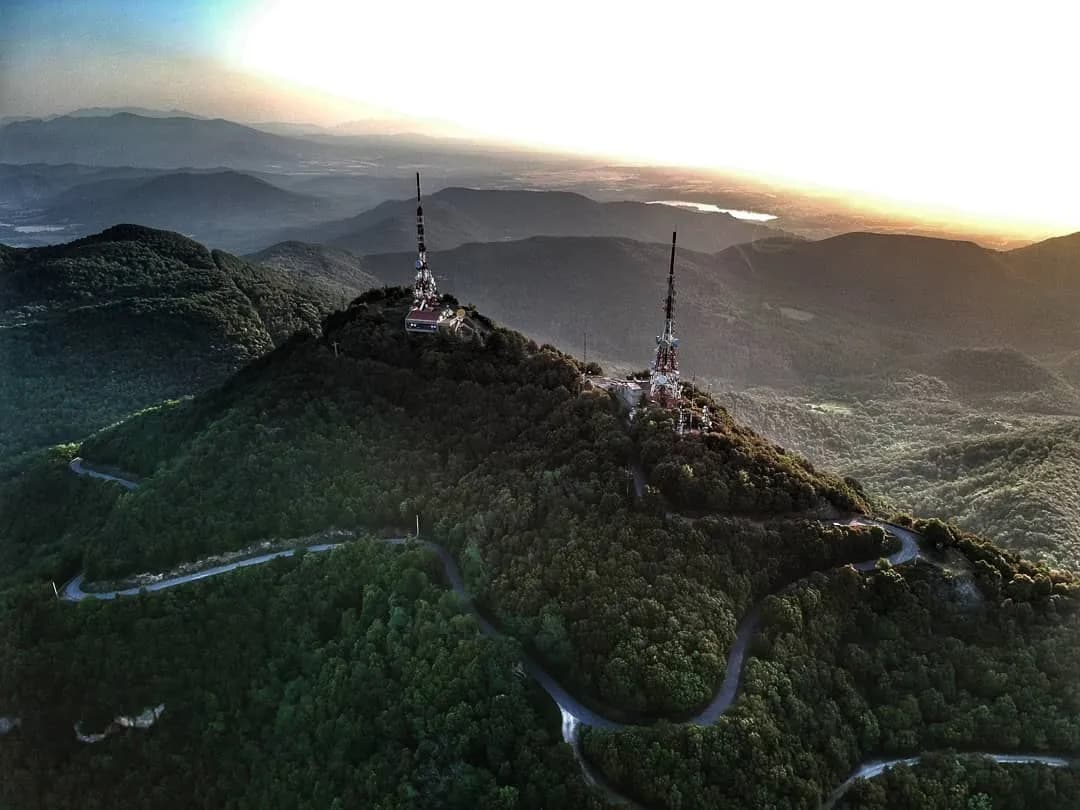
Girona — Rocacorba
There is a climb outside Girona that professional cyclists use as a measuring stick. Not for its length, not for its views, though both are considerable — but for its honesty. Rocacorba gives you exactly what you put in, no more.
71 km
Distance
1,295 m
Elevation
5h50
Duration
3 ravitos
Ravitos
There is a climb outside Girona that professional cyclists use as a measuring stick. Not for its length, not for its views, though both are considerable — but for its honesty. Rocacorba gives you exactly what you put in, no more. The gradient refuses to settle. It kicks, eases, kicks again. The forest closes around you. There is no traffic because the road goes nowhere except up.
This is why the best riders in the world have been coming here for twenty years.
The loop is 70.7 kilometres with 1,246 metres of climbing, almost all of it concentrated in one sustained effort between Canet d'Adri and the telecom towers at the summit. What surrounds that effort — the farmland north of Girona on the way out, the long rolling run home across the Gironès — is the kind of cycling that exists to put you in the right frame of mind. Quiet secondary roads, poplar lines, stone masies. The Guilleries and Collsacabra ridges slowly sharpening on the horizon as the legs warm up.
The road out
Roll north from the old town in the early light. Past the first roundabouts the traffic thins immediately and the gradient barely registers — this is a warm-up designed by the landscape itself. The roads are narrow enough to feel intimate but wide enough for a group. Through Canet d'Adri the character shifts. Oak woodland closes in. The village ticks past quietly. Something in the air changes.
The unofficial start of the climb is a brown sign for El Matamors at a shaded hairpin. From there it is proper Rocacorba — 9.9 kilometres at an average of 7.4 percent, with a Cat 1 classification that understates what the ramps in the upper section feel like after an hour in the saddle.
The climb
The gradient is never consistent and this is the point. You find a rhythm, the road kicks up, you stand, it flattens for a hundred metres, you sit, another ramp. Holm-oak and chestnut overhead, damp patches under the tyres even in dry weather, leaf litter in the corners. There is no traffic on this dead-end road — it serves the antennas at the top and nothing else — so you can use the full width through the hairpins and focus entirely on pacing.
The Strava segment KOM sits at 26:20. Do not think about this until you are already at the top.
The summit
The forest opens near the antennas and suddenly there is sky everywhere. The sticker-plastered Rocacorba Arribada board marks the place where every cyclist who comes to Girona eventually stops for a photograph. The Garrotxa volcanic hills roll north. Lake Banyoles catches the light down on the Pla de l'Estany. On a clear day the Costa Brava appears as a thin blue line to the east.
Take ten minutes. Pull on a gilet. The descent demands attention — damp hairpins, gravel washed across the apex, occasional pine cones in the corners. Use the full road and resist the instinct to descend fast early.
The return
Back through Canet d'Adri and onto the plain, the route opens under big Empordà skies for the final 30 kilometres home. The legs are doing the accounting from the climb but the roads keep you moving — fast, rolling, often a tailwind. The cathedral spires of Girona reappear ahead. You finish where you started, with the old town and the choice of where to sit down.
Route
70.7 km · +1,246 m · Road
| Segment | Notes |
|---|---|
| 0–15 km · Girona → approach roads | North out of the old town on secondary roads — poplar lines, stone masies, almost no traffic past the first roundabouts. Easy tempo to warm the legs. |
| 15–25 km · Approach to Canet d'Adri | The pavement narrows, oak woodland closes in. The gradient creeps in without announcing itself. Fill bottles here — nothing reliable until you're back down. |
| 25 km · El Matamors sign | The unofficial start of the climb. A brown sign at a shaded hairpin. From here it is proper Rocacorba. |
| 25–35 km · Rocacorba climb | 9.9 km · 7.4% avg · Cat 1. Gradient never settles — pitches, eases, kicks again. Holm-oak and chestnut overhead, full road width available, no traffic. |
| 35 km · Summit (992 m) | Telecom towers, sticker-plastered Arribada board. Garrotxa hills north, Lake Banyoles below, Costa Brava on clear days. Pack a gilet before descending. |
| 35–45 km · Descent | Same road back down — damp hairpins, gravel on the apex, pine cones in the corners. Brake early, use the full road, don't be hasty. |
| 45–70.7 km · Gironès plain → Girona | Fast and rolling across open farmland. Often a tailwind. Cathedral spires reappear ahead. The legs are accounting for the climb but the roads keep you moving. |
71 km
Distance
1,295 m
Elevation
—
Average gradient
964 m
Summit altitude
Before you go
- Pace the climb from the bottom, not the topThe ramps in the upper section of Rocacorba are significantly steeper than the average suggests. Riders who go too hard on the more forgiving lower slopes — where the gradient feels honest and manageable — pay for it above the tree line where the road kicks above 10% before the summit. Start conservatively. The climb rewards patience more than power.
- Fill both bottles in Canet d'AdriThere is no reliable water source between the village and the summit, and nothing on the descent either until you are back through Canet. At 25 kilometres in with the entire climb ahead, this is not a stop to skip
- Pack a gilet regardless of the forecastThe summit sits at 992 metres and the forest keeps the air cold well into spring. The descent from the top lasts long enough for a chill to set in through damp kit. A light shell folded into a back pocket adds nothing to the ride up and makes a material difference on the way down
- The descent is more technical than the numbers suggestRocacorba is a dead-end road and the surface reflects that — damp patches persist in the forest even in dry summer weather, gravel washes across the apex on the tighter hairpins, and pine cones accumulate in the corners. Descend at the pace you can modulate, not the pace the gradient offers.