L'Estérel — La Route des Cols
Take a breath. Col de Théoule, Col des Trayas, Col de la Cadière, Col des Trois Termes, Col des Suvières, Col de l'Aire de l'Olivier, Col de l'Essuyadou, Col du Mistral, Col du Baldou, Col du Perthus.
57 km
Distance
1,115 m
Elevation
3h50
Duration
2 ravitos
Ravitos
Ten cols. One circuit. All on gravel. The Route des Cols of the Estérel massif was never quite the secret it was meant to be — the trail runners and mountain bikers found it first, then the gravel riders, and now anyone with a GPS and the right tyres knows what it is. The name alone should have been enough of a signal.
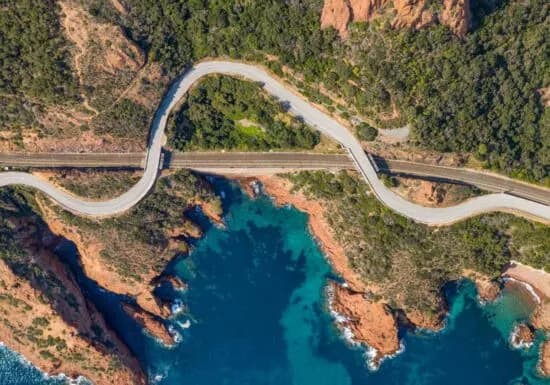
Between Nice and Cannes, forty kilometres from the Promenade des Anglais, there is a national park that most visitors to the Côte d'Azur will never see. They drive through it on the A8 without knowing it exists. The Massif de l'Estérel is green forest, red volcanic rock, and Mediterranean sky — a car-free playground of forest double-tracks that connects ten cols through terrain that has no equivalent on the Riviera.
What kind of place this is
The Estérel is geologically strange. The red rock — rhyolite and porphyry, volcanic in origin — gives the massif a colour that looks wrong against the blue sea and the green pines. This landscape was once part of Africa, separated from the European continent by millions of years of tectonic drift, and arriving at the ridge of the circuit you can believe it: the terrain has a foreign quality, a heaviness in the rock, that the limestone Alps to the north do not share.
Notre-Dame d'Afrique stands in the hills above — a statue memorialising African companions fallen in war, a reminder that this landscape carries history beyond the cycling maps.
The national forest service maintains the DFCI tracks through the massif. Two forestry houses mark the route — staffed outposts responsible for the health of the pine forests, the chestnut trees, the fig trees and olive groves, the eucalyptus imported from Australia and now as Mediterranean as the mimosa. One of the forestry houses carries a sign warning visitors to beware of alligators. No alligators have been confirmed. The sign remains.
Getting there
Théoule-sur-Mer is the start point. Forty-two kilometres from Nice by road — close enough to drive but better to take the train, which runs regularly along the coast and deposits you at the village with the sea immediately below. The circuit is 65 kilometres. Take the train out and ride back, or complete the loop and take the train home. Either works.
Leave the car in Nice. This is a coastline where logistics reward public transport.
The circuit — col by col
Théoule to the first climbs · Km 0–8
From the station in Théoule a short detour south leads to the Port de la Rague — worth the five minutes for the view of the cove before the climbing begins. Turn right along the coast and onto the Cadière gravel track. The first climbs are immediate and steep. The route does not warm up — it announces its character from the first pedal stroke.
This steepness is the Estérel's way of separating the people who read the route description from those who didn't. The initial gradients settle after two kilometres into the more measured rhythm of the forest tracks, but the opening section requires presence of mind and the right gear selection. Do not arrive at Théoule having underestimated what follows.
The forest interior · Km 8–35
The middle section of the circuit is the Estérel at its most complete. Forest double-tracks through pines and eucalyptus, red gravel under the wheels, brief glimpses of the Mediterranean through the trees when the trail climbs above the forest canopy. The ten cols arrive in sequence — not the dramatic alpine kind with open views and sustained gradients, but the miniature forest variety: a rise, a crest, a descent into the next valley, another rise.
The route is a roller coaster of short ascents and descents, forest crossings, track junctions. A GPS is not optional here. The Estérel has no single obvious line — the double-tracks multiply and intersect in ways that are difficult to navigate without a downloaded route. Download the GPX before you leave. Check it at the junctions. The forest looks similar in most directions.
Two forestry houses mark progress through the interior. The second — Maison Forestière Trois Termes — marks the beginning of the return arc.
The Piste Castelli and the eastern return · Km 35–50
The well-named Piste Castelli — a rare flat and fast section in a circuit characterised by neither — provides a respite before the final sequence of cols toward the east. The track runs straight through the forest, quick enough to recover the legs before the Col du Mistral arrives.
Col du Mistral to Col de Baladou to Col des Suvières — the final col sequence delivers you back to the Maison Forestière from the eastern approach. The names are correct: this section earns them. By the time you've crossed the Trois Termes junction you have been climbing and descending for three hours through terrain that allows no cruising and rewards no inattention.
The Rocher des Monges and the finish · Km 50–65
After the Maison Forestière the circuit crests the Rocher des Monges — the last significant rise before the descent back to the coast. From the top, the Mediterranean appears below, the coast road visible through the trees, the town of Théoule-sur-Mer laid out at the bottom of the descent.
The descent to the sea is the reward the route has been withholding. Fast, technical in the final section, ending at the coast with the option to swim, drink something cold, or simply sit and let the circuit settle.
The train back to Nice leaves from Théoule. If your legs still work, the coast road is 42 kilometres and flat. The decision usually makes itself.
The colour question
Road cycling on the Côte d'Azur is a blue and white affair — sky, sea, limestone, tarmac. The Estérel is something different: the red volcanic rock against the green pines and the blue Mediterranean is a colour combination that you don't find elsewhere on the Riviera. It photographs better than it sounds and sounds better than most things.
This is why riders come back. Not just for the cols — for the specific quality of afternoon light on red rock above the sea, which is not available anywhere else and which no amount of road cycling in the region provides.
Fire risk — critical information
The Estérel is one of the highest fire-risk zones in France. The combination of dry Mediterranean heat, resinous pines, and mistral winds in July and August creates conditions where access to the massif is regularly restricted or closed entirely. Before any summer visit, check the bulletin issued by the emergency services for the département du Var. Fires are prohibited in the park year-round. In high-risk periods, the park can close with no notice.
October to June is the window. Summer is possible but requires checking conditions the morning of the ride. Plan accordingly.
Practical notes
- The first climbs from Théoule are steep from the start — no warmup. Arrive ready
- Water at the two forestry houses when staff are present — do not rely on this. Carry two full bottles minimum
- The forest tracks look similar at junctions — follow the GPX at every crossing
- The Piste Castelli section is fast in both directions — the only genuine recovery opportunity on the circuit
- Tyres: 40mm minimum. The rocky sections in the upper circuit are unforgiving on narrower tyres
- The train from Nice to Théoule takes approximately 45 minutes and runs hourly
- The swim at Théoule after the circuit is not optional — it is the correct conclusion to the day
57 km
Distance
1,115 m
Elevation
—
Average gradient
462 m
Summit altitude
Before you go
- Start / FinishThéoule-sur-Mer
- Cols10
- SurfaceGravel double-track, some rocky sections
- Roughness6/10