RAVITO.
10 saved
RoadSpain

Girona — Banyoles

There is a version of Girona cycling that has nothing to do with climbing.

50 km

Distance

418 m

Elevation

2h30

Duration

2 ravitos

Ravitos

There is a version of Girona cycling that has nothing to do with climbing. No Cat 1 summits, no threshold efforts through pine forest, no sticker-plastered boards at the top of a dead-end road. This is the other version — the one that rolls north over a rust-red bridge, threads quiet farm roads through a flat plain, and ends at the edge of a lake with a coffee and the Pyrenees on the horizon.

The Banyoles loop is 48.2 kilometres with 378 metres of climbing. It is the ride the local pros do when the legs need a day off. It is the first ride most visitors do when they arrive. It is proof that the country around Girona does not need altitude to be worth the effort.

Out of the city

The Pont del Dimoni marks the moment the city lets go of you. The rust-red steel arches swing overhead, the Ter slides below, and north through Sarrià de Ter the traffic begins to thin. A short ridge at Sant Julià de Ramis — barely enough to qualify as a climb — shakes out the legs and deposits you on the far side with the Pla de l'Estany opening ahead.

From here the roads are the kind that exist for cyclists and local farmers and nothing else. Patchwork cereal fields, alfalfa, stone masies sitting up on low ridges as if they have been there since the landscape was made. Horses stand right against the guardrail and watch you pass without concern. The tarmac is smooth and quiet. On a clear morning the Pyrenees are a blue smudge to the north, and the riding asks nothing more of you than to look up occasionally and notice where you are.

The run-in to Banyoles

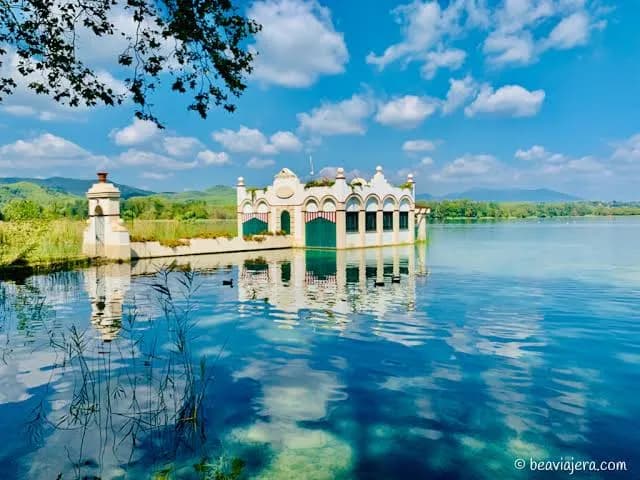
The approach to the lake is the best stretch of the route. Pine-capped hills, verges crowded with poppies and wild mustard in spring, the warm-hay smell that belongs to Catalonia in April and nowhere else in the same way. Then the road drops you at Llac de Banyoles — the largest natural lake in Catalonia, the rowing venue from the 1992 Barcelona Olympics, and, on a Tuesday morning in May, the quietest place within an hour of Girona.

Roll a slow lap along the Passeig Darder. Stop at one of the waterfront terraces. This is the traditional mid-ride pause on this loop and it earns its place — not because the body needs refuelling at 32 kilometres, but because the lake deserves more than a glance through the bars as you pass.

The return

The return leg is softer and more pastoral than the outbound. Small villages, harvested golden fields against still-green wheat, the Girona skyline assembling itself slowly on the southern horizon. There is a mild sting in the last rollers before the Onyar bridges reappear — enough to remind the legs they have been working, not enough to require a plan. Cross the river, drop back into the old town, and let the ride close itself down at whatever pace feels right.

Route

48.2 km · +378 m · Road

SegmentNotes
0–8 km · Girona → Sant Julià de RamisNorth over the Pont del Dimoni — rust-red steel arches, the Ter below. Through Sarrià de Ter, a short ridge at Sant Julià shakes out the legs. Traffic drops away immediately after.
8–22 km · Pla de l'EstanyThe plain opens. GI- secondary roads — smooth, quiet, barely used. Cereal fields, alfalfa, stone masies on low ridges. Horses against the guardrail. Pyrenees on the northern horizon in clear weather.
22–32 km · Approach to BanyolesPine-capped hills, poppies and wild mustard along the verges in spring. The gradient eases and the road drops gently toward the lake.
32–36 km · Llac de BanyolesPasseig Darder lakeside loop. The traditional coffee stop — waterfront terraces, rowers on the water, no reason to hurry. Fill bottles here before the return leg.
36–48.2 km · Return through the Ter plainsSofter and more pastoral than the outbound. Small villages, golden fields, the Girona cathedral reappearing on the horizon. A few rollers near the finish before the Onyar bridges and the old town.

50 km

Distance

418 m

Elevation

2.5%

Average gradient

210 m

Summit altitude

Before you go

  • Leave early to cross the Pont del Dimoni before the traffic builds.The bridge sits on a feeder road for the N-II and the morning rush is real. Before 8am it is a pleasure — the river light, the steel arches catching the early sun, almost no cars. After 9am on a weekday it is a different experience entirely.
  • Stick to the GI- secondary roads throughoutThere is a parallel main road on parts of the outbound leg that is technically rideable. It is louder, faster, and not worth it. The secondary roads are why this loop exists — take them even if they add a kilometre or two to the line.
  • The lakeside stop at Banyoles is part of the ride, not optionalAt 32 kilometres with less than 400 metres of total climbing, the body does not need the break. The ride does. The Passeig Darder terraces face the water, the rowers are usually out by mid-morning, and the coffee is adequate. Take fifteen minutes. The return leg feels different afterwards.
  • Watch for the tramuntanaThe north wind that sweeps down from the Pyrenees across the Pla de l'Estany can be significant on exposed stretches of the outbound leg. On days when it is blowing, lean into it on the way out and enjoy what it gives you on the way home — the return leg becomes fast and effortless in a way that feels disproportionate to the effort spent.
  • This is the recovery ride, not the warm-upThe temptation after a hard day on Rocacorba or Sant Martí is to use this loop as a tempo run. Resist it. The Banyoles loop earns its reputation as a reset — legs turning over, eyes up, no power numbers. The countryside around the Pla de l'Estany is best appreciated at the pace it was designed for.

This is the kind of place we write about every week.

Get the Ravito guide in your inbox.

No noise. Unsubscribe anytime.

Newsletter details