The 3 Nations Route — Puigcerdà, Andorra, France
Three countries, one day.
140 km
Distance
2,232 m
Elevation
7h00
Duration
4 ravitos
Ravitos
The route exists because of a geographical accident. Puigcerdà sits at 1 152 metres in the Cerdagne valley, at the point where Spain, France, and Andorra converge within a radius of thirty kilometres. Someone in the Club Ciclista de Puigcerdà understood, in 1980, that a road connecting all three could be made into a cycling route. Forty-five years and 44 editions later, the 3 Nacions remains what it always was — the only cycling route in the world that crosses three countries, and one of the finest days on a road bike that the Pyrénées can offer.
The numbers are honest. 140 kilometres, three countries, the Port d'Envalira at 2 407 metres — the highest paved mountain pass in Europe. Not a hard day by Alpine standards. A complete day by any standard — one that requires preparation, pacing, and the specific pleasure of arriving somewhere for the first time while understanding, at each border crossing, exactly where you are.
What kind of route this is
The 3 Nacions is not a race and was never designed to be one. It is an épreuve focused on self-surpassing, endurance, and controlled riding rather than competition — a non-competitive cyclosportive that offers a unique and demanding experience through its high-mountain terrain, international atmosphere, and historic route.
This distinction matters. The route is demanding in the way that long Pyrenean days are always demanding — sustained, high-altitude, exposed — but the character is exploratory rather than competitive. You are here to cross three countries and summit the highest paved col in Europe, not to beat the rider in front of you.
Leave the ego in Puigcerdà. You will need what it was using.
The route in full
Departure from the Centre Sportif de Puigcerdà at 7:30am, heading toward Andorra via La Seu d'Urgell. From kilometre 70, the ascent toward the Port d'Envalira at 2 407 metres begins. After the summit, the descent toward Pas de la Casa, then the Coll de Puymorens on French territory. From there, the climb through La Tour de Carol and the return to Puigcerdà — 140 kilometres and 2 400 metres of elevation completed.
Section 1 — Puigcerdà to La Seu d'Urgell
Km 0–50 · Mostly descending · Valley riding
The route leaves Puigcerdà heading southwest through the Cerdagne valley. The first fifty kilometres are the route's most forgiving section — a long descent through the Alt Urgell, following the Segre river valley toward La Seu d'Urgell at 700 metres. The road passes through Bellver de Cerdanya and Martinet, small valley towns that exist at the intersection of the cycling world and the agricultural one. Through the three tunnels — Lles, Sant Martí dels Castells, Torres d'Alàs — which cut through the limestone ridges separating the valley sections.
Use this section for what it is: the warmup. Eat, drink, establish a rhythm. The climbing doesn't begin in earnest for another twenty kilometres.
La Seu d'Urgell is the natural break point. A proper Catalan town with a Romanesque cathedral — the Seu d'Urgell Cathedral, 12th century, Lombard influence — and the first ravito of the day. The town sits at the confluence of the Segre and Valira rivers, which is also the point where the Spanish Pyrenees give way to Andorra. From La Seu, the road enters the Valira valley and the gradient begins.
Section 2 — La Seu d'Urgell to Andorra la Vella
Km 50–70 · Gradual ascent · 700m to 1 023m
The twenty kilometres from La Seu to Andorra la Vella are a sustained but manageable climb through the gorge of the Valira del Nord. The gradient averages 3–4% — a long false flat that feels deceptively easy and is quietly exhausting. The scenery becomes more dramatic as the valley walls rise.
The border crossing into Andorra requires nothing — no passport check, no barrier, just a sign and the sudden appearance of duty-free shops that line the approach to Andorra la Vella. The capital of Europe's smallest country is also, at this point in the day, a place to fill your pockets. The shops are open early. There is no better moment to stock up on sugar.
Section 3 — Andorra la Vella to the Port d'Envalira
Km 70–90 · 1 023m to 2 407m · The defining climb
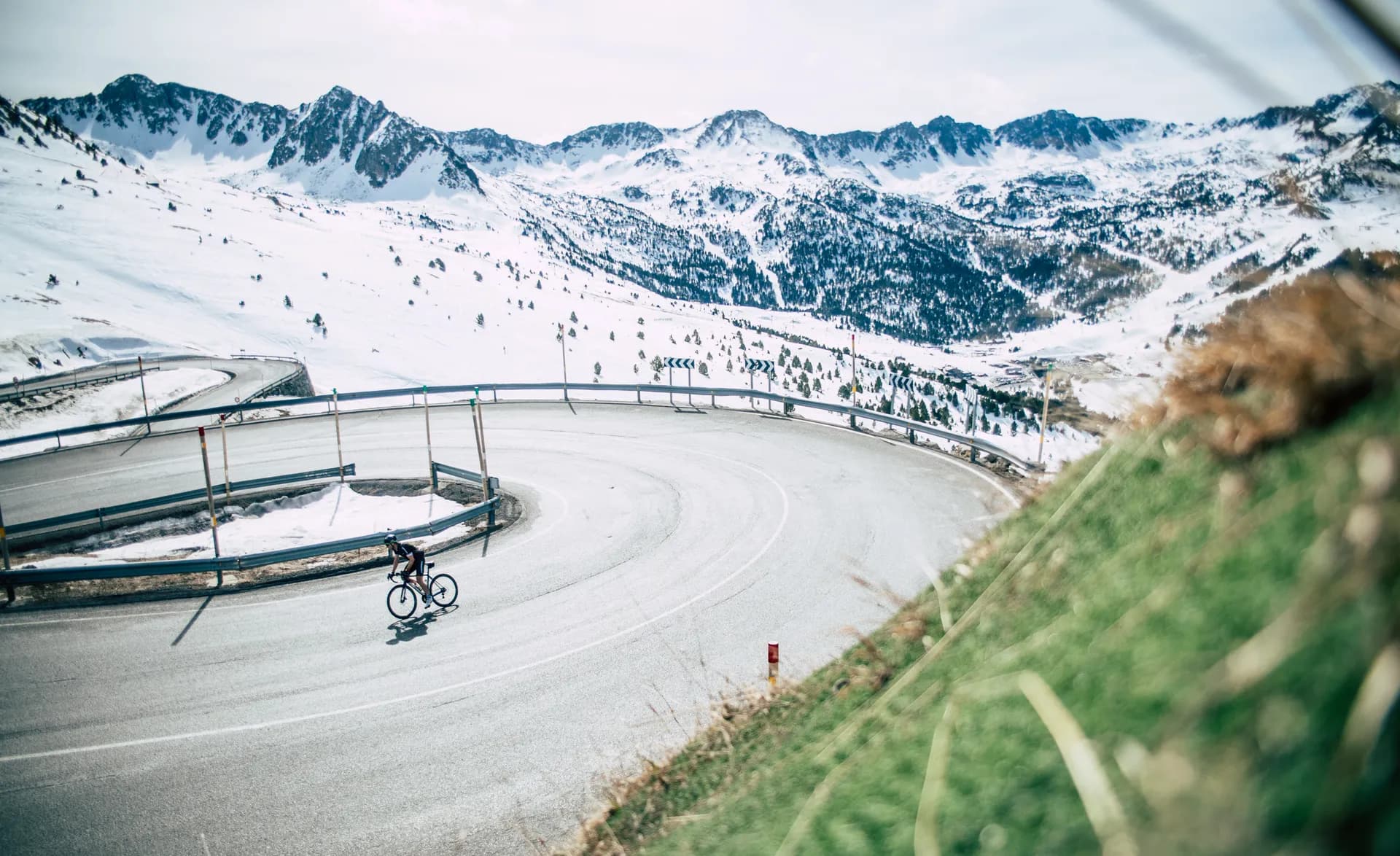
This is the day's centrepiece and the reason the 3 Nacions has survived 44 editions. The Port d'Envalira, summit at 2 407 metres, is the highest paved mountain pass in Europe. The ascent from Andorra la Vella is 20 kilometres at an average of 6.7%, climbing through the Valira d'Orient valley before emerging onto the high plateau that leads to the summit.
Encamp to Grau Roig · Km 70–83
The lower section climbs through Encamp and the ski resort infrastructure that defines Andorra's visual identity in this valley. The gradient is consistent — 6–7% — through a landscape that transitions from town to resort architecture to forest to open alpine terrain. Above Grau Roig at 1 800 metres the trees end and the upper Andorra appears: wide open snowfields in winter, high pasture in summer, the road threading across the plateau with the summit visible from several kilometres out.
Grau Roig to the summit · Km 83–90
The final seven kilometres to the summit are the most exposed on the route. The gradient is gentler — 4–5% average across the plateau — but the altitude, the wind, and the accumulated effort of eighty kilometres make them feel harder than the numbers suggest. The temperature at the summit is typically 12–15°C below the valley floor. The temperature sign at the Port d'Envalira at 2 408 metres reads 19.2°C at 11am on a June morning. In less favourable conditions it reads considerably less.
The summit is marked by the familiar border signs, a small café, and on the 3 Nacions day, several hundred cyclists in various states of controlled suffering. The view — the Pyrenean ridge extending in both directions, Andorra falling away below, the French side beginning on the other face — is the reward for whatever the ascent cost.
The border — into France
The descent from the Port d'Envalira drops through Pas de la Casa, Andorra's ski resort town at the French border, and crosses into France at the Col de Puymorens. The Col de Puymorens summit is at 1 915 metres, connecting Foix to the Cerdagne. It has featured several times in the Tour de France and was bypassed by a tunnel in 1994. The cycling route takes the col road, not the tunnel.
The descent from Puymorens into France is fast, smooth, and delivers you to the valley below with the third country completed. France, in this context, lasts approximately fifteen kilometres — from the Puymorens descent to the border crossing back into Spain near Latour-de-Carol.
Section 4 — Latour-de-Carol to Puigcerdà
Km 120–140 · Rolling · Return to the Cerdagne
The final section crosses from France back into Spain through the Cerdagne. The road climbs gently from Latour-de-Carol — the international railway junction where the broad-gauge Spanish train meets the narrow-gauge French mountain railway — back up to Puigcerdà at 1 152 metres. Twenty kilometres of rolling Pyrenean plateau with the finish visible across the valley.
By this point the legs have crossed three countries and 2 200 metres of climbing. The final twenty kilometres ask only that you continue. The Cerdagne valley in late morning, on a clear June day, provides sufficient motivation.
The Port d'Envalira in detail
Start - Andorra la Vella · 1 023 m Distance - ~20 km Elevation - 1 384 m Average gradient - 6.7% | Max gradient - 10% Summit - 2 407 m
Practical notes
- The descent from Envalira to Pas de la Casa is fast and exposed — hands on the drops, wind layer ready at the summit
- The tunnels on the Spanish section (Lles, Sant Martí dels Castells, Torres d'Alàs) require front and rear lights — carry both
- Water at La Seu d'Urgell (km 50), Andorra la Vella (km 70), and the summit café at Envalira — fill at every opportunity
- The Andorra duty-free shops between Andorra la Vella and Pas de la Casa are the best mid-route provisioning on any Pyrenean circuit
- Start early. The Port d'Envalira in afternoon heat, after 90 kilometres, is a different climb from the Port d'Envalira at 11am on fresh legs
- Tyres: standard road tyres are correct — the surface is tarmac throughout. No gravel preparation required
- The return section from Latour-de-Carol to Puigcerdà climbs — budget the energy accordingly
140 km
Distance
2,232 m
Elevation
6.7%
Average gradient
2,407 m
Summit altitude
Before you go
- High pointPort d'Envalira
- CountriesSpain · Andorra · France
- Key colsPort d'Envalira · Col de Puymorens
- SurfaceTarmac throughout